


Ford Explorer vs. Ford Expedition for Three-Row SUV Buyers
Ford Explorer. Ford Expedition. Both wear a Blue Oval and seat your entire crew. But apart from their capability, safety, and commitment to quality, each is a very different vehicle. They’re built on very different platforms for very different jobs, though, and picking the wrong one shows up fast. Not on paper. It shows up the first Saturday you try to load baseball gear into a third-row-up cargo hold that’s six inches shorter than you needed.
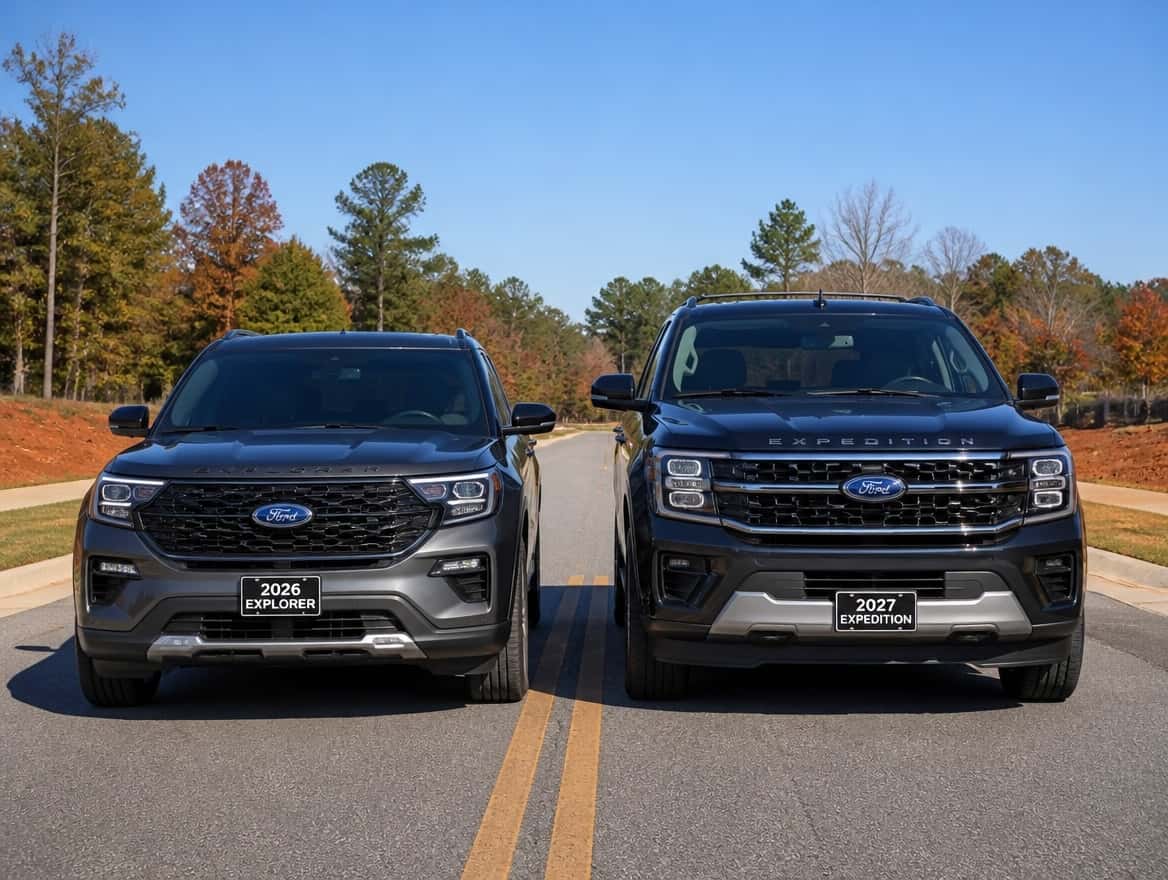
We’ll give you the straight answer before we go any further. If your ideal third-row seat is one that’s used in a pinch, and spends most its time folded flat in order to haul cargo, the 2026 Ford Explorer may just fit your life better and will cost less to own. If your third row stays up for older passengers on a more consistent basis, or you tow anything north of 5,000 pounds, the Expedition earns its keep.
The short version
- Occasional third-row use, city driving, fuel economy priority: 2026 Explorer (2.3L or Hybrid) is the pick.
- Regular full-row seating for five-plus riders or towing beyond 5,000 lbs: 2027 Expedition handles it without compromise.
- Central Alabama commuters watching the pump: the Explorer Hybrid’s EPA-estimated 40 MPG combined is in a different league from any full-size SUV.
- Tight parking or east-side Montgomery school car lines: the Explorer’s 198.7-inch length is noticeably easier to thread than the Expedition’s 209.9 inches.
- Serious cargo with all rows occupied: only 16.3 cu ft sits behind the Explorer’s third row versus 21.6 cu ft behind the Expedition’s; that gap matters on road trips.
How Do These Two Fords Actually Compare?
Line the specs up side by side and the platform gap drives every other difference you’ll see here. The Explorer is a unibody crossover tuned for daily driving, while the Expedition rides on a body-on-frame truck chassis, the same basic architecture under the F-150, so it trades easy maneuvering for muscle and space. That distinction shapes everything below.
| Feature | 2026 Ford Explorer | 2027 Ford Expedition |
|---|---|---|
| Platform | Unibody crossover | Body-on-frame (truck chassis) |
| Overall Length | 198.7 in | 209.9 in (SWB) |
| Seating | Up to 7 | Up to 8 |
| Cargo Behind 3rd Row | 16.3 cu ft | 21.6 cu ft (SWB) |
| Max Cargo (all rows folded) | 85.8 cu ft | 108.5 cu ft |
| Max Towing (properly equipped) | 5,000 lbs | 9,600 lbs (4×4 + HD Tow Pkg) |
| Standard Engine | 2.3L EcoBoost I-4 (300 hp) | 3.5L EcoBoost V-6 (400 hp / 480 lb-ft) |
| EPA Combined (base, RWD) | 24 MPG | 19 MPG |
| Hybrid Available | Yes (Explorer Hybrid, ~40 MPG combined) | No |
| Best For | Daily-driver families, lighter towing | Larger families, heavy trailers, max cargo |
Ford publishes all of these figures on its model specification pages, and every number above reflects properly equipped vehicles. Towing ratings in particular swing with configuration, so confirm the exact package on any vehicle you’re considering.
Does the Size Difference Actually Matter for Your Daily Drive?
For most Montgomery families the answer is yes, and it lands sooner than you’d expect. The Explorer slips into a standard single-car garage with room to open the liftgate, while the Expedition’s longer body starts dictating where you can park and how you thread a carline. The 11 inches between them is real.
The Explorer’s 198.7-inch overall length fits a standard single-car garage with room to open a liftgate. On the standard wheelbase the Expedition’s 209.9 inches (and 221.7 on the MAX) can force some creative parking math, especially in older Montgomery neighborhoods where garages were built in a different era and school carlines have no room to spare. Our team walks buyers through this at the lot, and that 11-inch spread is the first thing families with tight driveways need to plan around.
The Explorer also steers more like a car than a truck. That unibody architecture gives it a tighter turning diameter and a lighter feel on surface streets. On Eastern Boulevard or in the Shoppes at EastChase parking deck on a Saturday afternoon, that shows up as less stress behind the wheel. The Expedition drives well for its size, but it’s a full-size body-on-frame vehicle and it handles like one.
Now for the tradeoff: The Explorer’s third row is genuinely tight for adults on a long haul. Ford lists 31.8 inches of legroom in the Explorer’s third row. An adult over about 5’8″ will feel it on a two-hour run down I-65 to Mobile. The Expedition’s full-size body-on-frame cabin solves that. If you’ve got teenagers who actually ride back there week after week, the Expedition is the honest recommendation.
On towing, the gap is large. The 2027 Expedition 4×4 with the Heavy-Duty Trailer Tow Package is rated at up to 9,600 pounds when properly equipped, and the standard 3.5L EcoBoost makes 400 horsepower and 480 lb-ft of torque. The Explorer tops out at 5,000 pounds across all trims when equipped for it. A pontoon boat or a loaded aluminum fishing trailer often lands in the 3,500 to 4,500-pound range, well within the Explorer’s reach. A large camper or a full-sized travel trailer almost always pushes past it.
Which Ford Three-Row SUV Fits Your Situation?
There isn’t one right answer here, only the right answer for how your week actually runs. It comes down to two questions: how often that third row holds real passengers and how heavy a trailer you drag behind it. Answer those honestly and the pick sorts itself out.
Choose the 2026 Explorer if:
- Your third row folds down more days than it’s occupied by passengers
- You drive I-85 or Eastern Boulevard daily and want the EPA-estimated 24 MPG combined from the 2.3L RWD without thinking about it
- You’re considering the Explorer Hybrid, which earns an EPA-estimated 40 MPG combined and pays off in the stop-and-go of Montgomery’s east-side commute, a meaningful advantage at the pump over a full year
- Your towing need is a ski boat, a utility trailer, or a small camper at or under 5,000 lbs
- Parking matters, and standard garages, tighter spaces, and school carlines are all easier in 199 inches than in 210
Choose the 2027 Expedition if:
- You regularly carry six, seven, or eight people with actual cargo behind them
- Teens or adults are regular third-row riders on trips longer than an hour
- You tow a larger boat, a horse trailer, or a camper that tips past the 5,000-lb mark
- The Expedition MAX version appeals because your family does genuine road-trip cargo hauling with all seats occupied, since the MAX keeps 36.1 cu ft behind its third row against 16.3 on the Explorer
- You want the body-on-frame ride quality and structural confidence of a truck-based platform on long highway miles
The Explorer Hybrid deserves a callout for one specific Montgomery buyer. Picture the state employee, the plant-shift worker, or the Maxwell Air Force Base family covering 18,000 to 25,000 miles a year in a primary family vehicle who wants three-row capability without full-size operating costs. The EPA-estimated 40 MPG combined on the Explorer Hybrid isn’t a compromise position. It’s a category distinction. No full-size three-row SUV on the market offers anything close to that figure.
Frequently Asked Questions
Is the Ford Explorer or the Ford Expedition better for families with young children?
Families with young children in car seats often find the Explorer easier to manage day to day. Its shorter overall length of 198.7 inches, lighter unibody feel, and easier parking geometry suit the school-run, grocery-run rhythm well. The Explorer’s captain’s chair second-row configuration also makes buckling car seats reachable without climbing into the vehicle. Families with multiple children who’ll grow into regular third-row use should price and sit in both, because the Expedition’s larger cabin becomes more comfortable as kids get older.
Does the Explorer Hybrid really make sense as a three-row SUV?
The Hybrid makes sense for the right buyer. The 2026 Explorer Hybrid earns an EPA-estimated 40 MPG combined, making it the most fuel-efficient three-row SUV Ford builds. It carries three rows of seating, up to 5,000 pounds of towing capacity when properly equipped, and all the same cargo flexibility as the standard Explorer. If you’re piling on local miles and want to avoid the operating cost of a full-size SUV, the Hybrid version of the Explorer is a genuine option, not a footnote.
0 comment(s) so far on Ford Explorer vs. Ford Expedition for Three-Row SUV Buyers