

F-150 vs. Super Duty for Montgomery Towing: Which Ford Fits Your Load?
The towing mistake that’s easiest to make happens well before the trailer is ever hitched. You pick the wrong truck, and no amount of careful driving fixes that. Get your load weight in hand before you read another word. That number decides everything.
The 2026 F-150 is a genuinely capable half-ton. Ford lists its maximum conventional towing at 13,500 lbs when properly equipped with the 3.5L EcoBoost V6 and the Max Trailer Tow Package. For plenty of central Alabama towing, that truck is more than you need. For plenty more, it falls short. You’ll know which side of that line your load sits on by the end, and that’s what this guide is for.
What Load Are You Pulling, and How Heavy Does It Actually Get?
Loaded weight is the single number that settles the F-150 versus Super Duty debate faster than any spec sheet, and it’ll cover most towing cleanly, with the horse-trailer and heavy-flatbed edge cases being the exception that calls for a closer look at your engine and package. Our team leans on this real-world logistics table when someone walks in asking which truck to buy for their trailer.
| Load Type | Typical Loaded Weight | F-150 Handles It? | Truck We’d Recommend |
|---|---|---|---|
| Bass boat, 17-19 ft (with trailer) | 2,000-3,500 lbs | Yes, comfortably | 2026 F-150 (any engine) |
| Pontoon, 20-24 ft (with trailer) | 5,000-8,500 lbs | Yes, check your config | 2026 F-150 (3.5L EcoBoost, properly equipped) |
| Two-horse trailer, loaded | 7,000-9,000 lbs | At the edge | 2026 F-250 Super Duty |
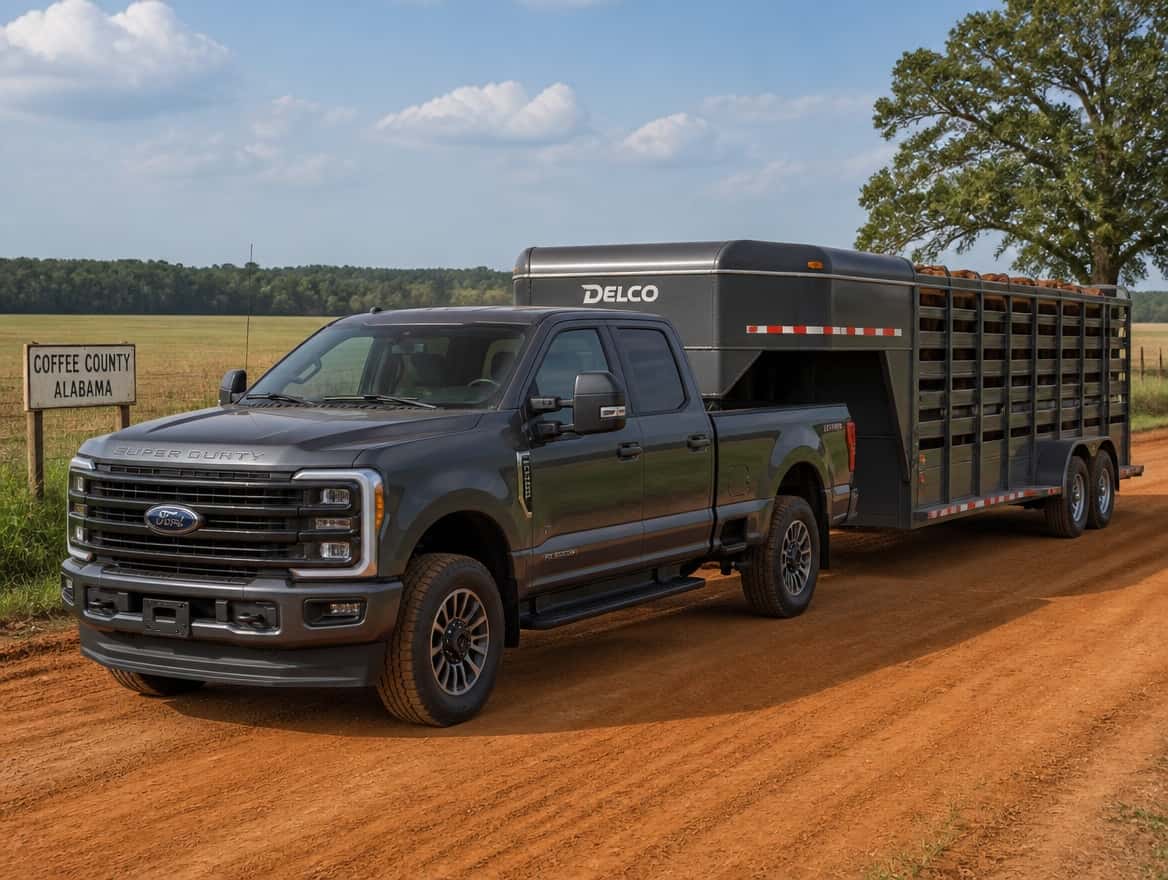
| Large livestock/gooseneck | 10,000+ lbs | No | 2026 F-250 or F-350 Super Duty |
| Utility flatbed, light equipment | 3,000-6,000 lbs | Yes | 2026 F-150 (3.5L EcoBoost) |
| Flatbed, heavy equipment or skid steer | 10,000-14,000+ lbs | No | 2026 F-350 Super Duty DRW |
A few things jump out from that table. First, the F-150 covers a wide range of recreational and light-work towing. A bass boat to Lay Lake or a utility trailer across town? That truck won’t break a sweat. Second, the “at the edge” line lands on the two-horse trailer. Our team watches that threshold closely because loaded horse trailers are part of everyday towing around the River Region, and a truck pulling at or near its published ceiling drives differently than one pulling at 70% of capacity.
Check your specific truck’s certification label before you trust any advertised number. Ford’s maximums apply only when the truck carries the right engine, axle ratio, and tow package. A base-trim F-150 with the 2.7L EcoBoost doesn’t show 13,500 lbs on its window sticker. The number there reads 8,400 lbs. Know your truck’s certification label before you hook up.
When the F-150’s Ceiling Becomes the Super Duty’s Floor
The 2026 Super Duty moves into a different class of truck once your load climbs past what a half-ton is built to carry, and the heavier hardware underneath is what earns that gap, so the choice turns on weight rather than preference. The badge isn’t doing the work here.
The 2026 F-250 Super Duty with the available 6.7L High Output Power Stroke diesel puts out 500 horsepower and 1,200 lb-ft of torque, and with the right configuration it’s rated for up to 22,000 lbs of conventional towing. The F-350 DRW pushes that to 28,000 lbs conventional and 38,000 lbs with a gooseneck hitch.
Those numbers live in a different mechanical world from the F-150. They’re built on a heavier frame, a stronger rear axle, and a dedicated commercial-grade chassis.
The F-250 Super Duty makes sense for loaded horse trailers, heavier pontoons, farm equipment pulls, and commercial work where payload also matters (the F-250 carries up to 4,246 lbs in the bed, versus the F-150’s 2,440 lbs maximum). The F-350 Super Duty steps in for gooseneck livestock trailers, heavy flatbeds, and anything you’re pulling regularly above 15,000 lbs.
The tradeoff is worth saying plainly. A Super Duty is harder to park, it burns more fuel on non-towing days, and the DRW configuration runs noticeably wider in tight spaces. If you’re towing light two or three times a year and running errands the other 350 days, the F-150 is probably your daily driver. If your trailer spends more time out of the barn than in it, the Super Duty earns back its learning curve fast.
Before You Hitch Up: A Towing-Day Checklist
Run this checklist before every haul, give it five minutes, and you’ll head off most of the roadside trouble that comes from a loose connection, a low tire, or a brake controller nobody checked, on an F-150 or a Super Duty alike.
Our service team can verify your truck’s tow package installation, ball and hitch rating, and brake controller calibration if you’ve got any doubt about your setup.
Vehicle:
- Check the door-jamb certification label for your specific tow rating (not the advertised model maximum)
- Confirm the hitch ball size matches the trailer coupler (1-7/8″, 2″, or 2-5/16″)
- Verify the brake controller is on and calibrated to your trailer’s braked axle weight
- Check trailer wiring and lighting (left turn, right turn, brake, running lights)
- Confirm tire pressure on both truck and trailer (cold, before loading)
- Check transmission fluid level (especially important before a long pull in Alabama summer heat)
Trailer:
- Weigh your trailer loaded before the first trip of the season. Scales at commercial truck stops are generally accessible and accurate
- Confirm tongue weight is 10-15% of gross trailer weight
- Safety chains crossed under the coupler and properly attached
- Breakaway cable clipped to the truck’s safety chain anchor, not the ball mount
On the Road:
- Add following distance for your combined rig length (plan for it to take longer to stop)
- Know your route’s bridge weight limits if you’re running above 10,000 lbs loaded
- Central Alabama’s summer heat puts extra load on the cooling system and transmission. If you’re making a long pull between July and September, watch your temperature gauge and plan a rest if the truck signals it needs one
Schedule a Pre-Tow Service Check
Stivers Ford of Montgomery sits on Eastern Boulevard, and we stock both the 2026 F-150 and the full Super Duty lineup, including F-250 and F-350 configurations. If you’re not sure your current truck’s setup matches the load you’re planning, we can read the certification label with you, work through the configuration questions, and point you toward the right trade-in path if the numbers don’t line up, whenever you’re ready. Go pull something great.
0 comment(s) so far on F-150 vs. Super Duty for Montgomery Towing: Which Ford Fits Your Load?