


Ford F-150 vs. Ranger: Which Truck Fits Life in Central Alabama?
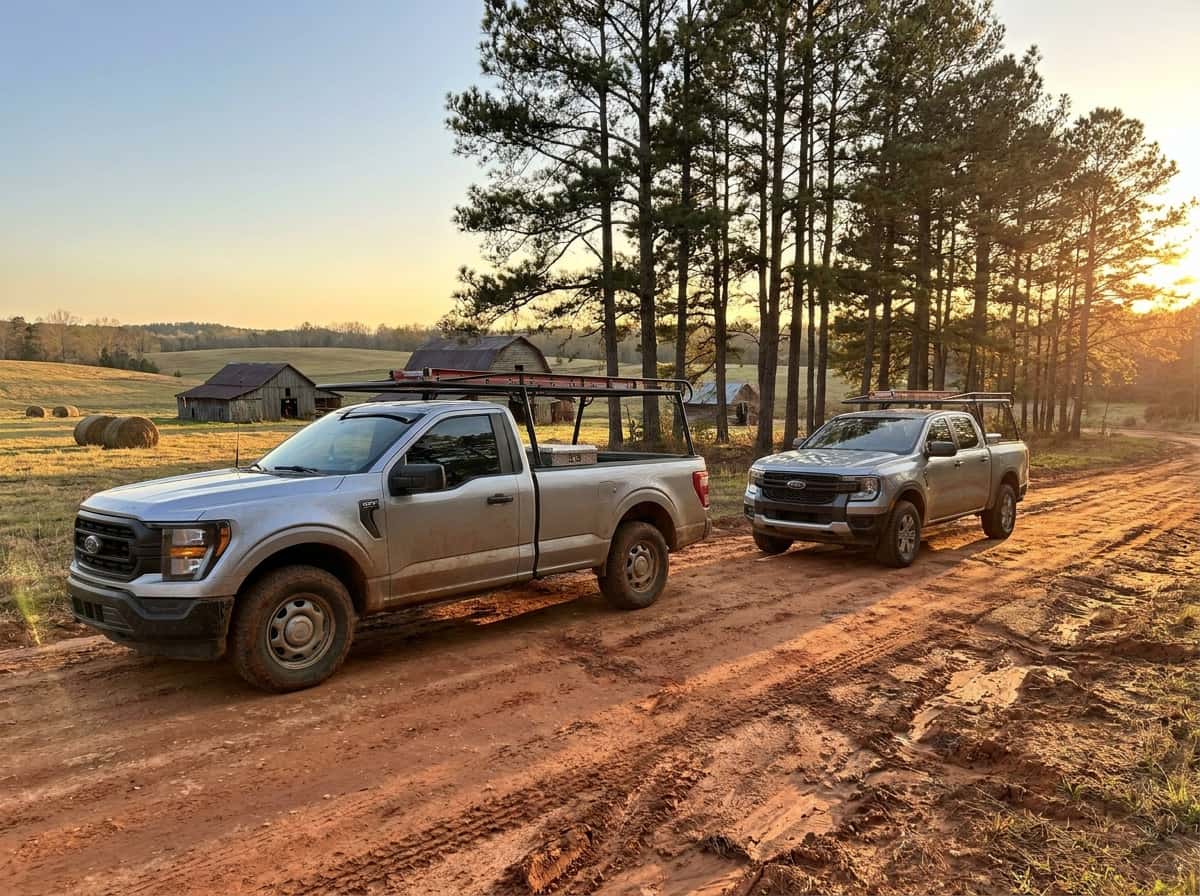
If your weekend involves navigating the Tallapoosa River with a 16-foot aluminum boat, and your weekdays involve hauling materials or commuting down I-65, the answer is probably not the same truck. After time with both, here’s our read. The 2026 Ford F-150 earns its keep when your loads regularly grow heavy, while the 2026 Ranger is possibly a better daily driver, especially if you don’t particularly need every inch of the F-150’s capability.
What’s the Real Difference Between These Two Ford Trucks?
Physical size and capability celings separate these two, and it starts with class: the Ranger is a midsize pickup while the F-150 is a full-size, and that one distinction carries through every number worth caring about, from what you can drag behind you to whether the truck tucks into a standard garage.
| Spec | 2026 Ford Ranger | 2026 Ford F-150 |
|---|---|---|
| Max Towing (properly equipped) | 7,500 lbs | 13,500 lbs |
| Max Payload (properly equipped) | 1,767 lbs | 2,440 lbs |
| EPA MPG (base engine, 2WD) | 21 city / 25 hwy / 23 combined | 19 city / 25 hwy / 21 combined |
| Overall Length (SuperCrew / standard) | ~210.6 in | ~232 in (6.5-ft bed) |
| Bed Length | 59.6 in (one option) | 66 in, 78 in, or 96 in |
| Bed Width Between Wheel Wells | 48.2 in | 50.6 in |
| Engine Options | 3 EcoBoost options | 6 engine options |
| Hybrid Available | No | Yes (PowerBoost, up to 25/26 MPG) |
All capacity figures are Ford-published and require proper equipment. See your doorjamb sticker for your specific vehicle’s ratings.
Does Towing Capacity Actually Matter for River Region Buyers?
If you’re regularly towing materials and equipment to a jobsite, or taking a boat to a local launch every weekend possible, then yes – it probably does. The 2026 Ranger tops out at 7,500 lbs properly equipped with the Trailer Tow Package (that’s either the 2.3L four-cylinder or the available 2.7L V-6), so picking the right pickup depends on whether your trailer lives below that threshold. A standard aluminum jon boat and trailer runs 1,000 to 2,500 lbs. A 20-foot fiberglass bass boat with a heavy outboard can push 4,000 to 5,500 lbs. The Ranger handles those with room to spare.
Load up a dual-axle equipment trailer, a fifth-wheel camper, or a large horse trailer, and the math changes fast. The 2026 Ranger maxes out quickly, while the F-150’s 3.5L EcoBoost can handle up to 13,500 lbs when properly equipped (nearly double). If anything you pull lives in that upper half, the F-150 isn’t just the better choice, it’s the only responsible one.
Bed Size, Cab Room, and the Plywood Problem
Bed width is where the spec sheets stay quiet, though it shapes real work more than the towing headline does. The 2026 Ranger’s bed measures 48.2 inches between the wheel wells. Given a standard sheet of 4×8 plywood is 48 inches wide, it can fit flat between those obstacles, but getting things to fit may prove slightly tricky. Step up to the 2026 F-150 at 50.6 inches between the wheel wells and you get a few extra inches of breathing room when you’re sliding materials in.
The Ranger’s bed is 59.6 inches long, inches shy of five feet in length. The F-150 gives you a choice of a 5.5-foot bed, a 6.5-foot bed, or a full eight-footer if you’re running lumber or pipe often. That flexibility means a lot to anyone in the trades or farming around the Black Belt counties.
On the other side of this, the Ranger’s overall length of about 210.6 inches (roughly 17.5 feet) is genuinely easier to live with day to day. A SuperCrew F-150 with a 6.5-foot bed runs about 232 inches – or just over 19 feet – long. Standard American home garages are commonly 20 feet deep. You can do that math. If you’re parking at EastChase or squeezing into a tight downtown Montgomery lot on weekdays, the Ranger’s smaller footprint isn’t a trivial advantage.
The F-150 also offers a SuperCrew cab with 43.6 inches of rear legroom, which is roomy for a back seat. A Ranger SuperCrew seats two adults in the rear comfortably, but it won’t feel the same on a long run to Huntsville with a full family aboard.
Daily Driving and Fuel Economy in Central Alabama Heat
Daily driving through central Alabama heat tilts the city fuel numbers toward the Ranger, because long summers mean extended idling and air conditioning working hard, and the EPA’s 2026 figures put the Ranger’s 2.3L at 21 MPG city against 19 city for the F-150’s base 2.7L, while the two trucks tie at 25 MPG on the highway.
Montgomery sits on the I-65 corridor in central Alabama. Stop-and-go through the Eastern Boulevard interchanges drags on economy more than steady highway miles do, so if most of your week is city driving, the Ranger’s edge shows up where you’ll feel it.
If you want a hybrid F-150, the 2026 PowerBoost is now available on more trim levels than before (including XLT and Lariat), and the EPA rates it at up to 25/ 26/ 25 MPG city/ highway combined in 2WD form. A PowerBoost F-150 on a daily I-65 commute from Millbrook or Prattville is an efficient truck, and it flips the fuel-economy argument on its head.
The PowerBoost also carries Ford’s Pro Power Onboard generator capability. It doubles as a power source for job sites or outdoor setups.
So Which Truck Should You Pick?
Neither truck is wrong for central Alabama, so the pick comes down to your load and your daily life, with the Ranger built for lighter everyday duty and the F-150 built for the heavy end where big trailers, long beds, and full crews come into play. Read yourself onto one of these two lists.
Buy the Ranger if you’re a daily driver and light-duty hauler who doesn’t tow over 7,500 lbs, would like better city fuel economy. Ranger is also a better choice if you prefer a truck that fits more naturally in a standard garage or parking structure, or you’re a first-truck buyer who wants real utility without the full-size commitment.
Buy the F-150 if you tow heavy loads often (horse trailers, campers, loaded equipment trailers, large boats), you need a longer bed for work materials, you want the PowerBoost hybrid’s fuel economy with full-size capability, or you routinely carry a full crew in the back seat on long hauls.
Both are capable Ford pickups that hold up in the heat, handle the roads around here, and carry the tech and towing features (Pro Trailer Backup Assist is on both) that make working with a trailer less stressful than it used to be. What truly separates them is your load and your daily life.
If you’re still deciding, walk the lot with us. We’ll put you in both and let the seat time do the talking. See our current F-150 and Ranger inventory or give our sales team a call at (833) 632-2778.
Frequently Asked Questions
Can the 2026 Ford Ranger tow a boat or camper?
Yes, the 2026 Ranger tows up to 7,500 lbs when properly equipped with the Trailer Tow Package, which covers most aluminum fishing boats, smaller campers, and utility trailers common in the River Region. Larger fiberglass boats with heavy outboards, or full-size travel trailers and fifth-wheels, will push past or exceed that rating, and that’s where you’ll want the F-150’s higher ceiling.
Does the 2026 Ford F-150 PowerBoost Hybrid make sense for a Central Alabama commuter?
It can. The EPA rates the PowerBoost at up to 25 city / 26 highway / 25 combined MPG (2WD), which beats the Ranger’s base engine on city numbers and nearly matches it everywhere else, while giving you full-size F-150 capability and the Pro Power Onboard generator feature. If you’re driving significant daily miles on I-65 or I-85 and still need the occasional heavy tow, the PowerBoost is worth a serious look.
0 comment(s) so far on Ford F-150 vs. Ranger: Which Truck Fits Life in Central Alabama?