


2026 Ford F-150 vs 2026 Ram 1500: Towing, Tech, and Ride Quality Differences
Few rivalries in the truck world run as deep as this one. The F-150 and Ram 1500 have been trading blows for years, and both have evolved significantly for 2026. They’re not trying to be the same truck. The F-150 leans into capability, versatility, and raw hauling muscle. The Ram 1500 doubles down on ride refinement and interior quality.
At Stivers Ford of Montgomery, we help Alabama truck shoppers sort through exactly these kinds of decisions every day. If you’re weighing both options, browse our current F-150 inventory while you work through this comparison. The real differences show up in how each truck handles a loaded trailer, holds up on a long commute, and performs when you actually need it to work. This breakdown covers powertrains, towing, ride quality, and technology so you can make a genuinely informed call.
Engine Lineups Compared: Power, Efficiency, and What Each Truck Offers
2026 F-150 Powertrain Options
Ford gives the F-150 one of the broadest powertrain menus in the segment. Every engine pairs with a 10-speed automatic transmission.
| Engine | Output |
| 2.7L EcoBoost V6 | 325 hp, 400 lb-ft torque |
| 3.5L EcoBoost V6 | 400 hp, 500 lb-ft torque |
| 3.5L PowerBoost Full Hybrid | 430 hp, 578 lb-ft torque |
| 5.0L V8 | 400 hp, 410 lb-ft torque |
| 3.5L High-Output EcoBoost | 450 hp, 510 lb-ft (Raptor only) |
| 5.2L Supercharged V8 | up to 720 hp, 640 lb-ft (Raptor R only) |
The PowerBoost Full Hybrid is the standout of the standard lineup. It pairs the 3.5L EcoBoost with an electric motor to produce 430 hp and 578 lb-ft of torque while actually improving fuel economy. No other engine in this comparison delivers hybrid efficiency alongside that level of output. The Raptor-exclusive engines are impressive, but they belong to a specialized trim category well outside the standard F-150 lineup.
2026 Ram 1500 Powertrain Options
Ram’s lineup is tighter, though it includes a notable engineering step forward. All engines pair with an 8-speed automatic transmission.
| Engine | Output |
| 3.6L Pentastar V6 | 305 hp, 269 lb-ft torque |
| 5.7L HEMI V8 | 395 hp, 410 lb-ft torque |
| 3.0L Hurricane twin-turbo inline-six (standard) | 420 hp, 469 lb-ft torque |
| 3.0L Hurricane twin-turbo inline-six (High-Output) | up to 540 hp, 521 lb-ft torque |
The Hurricane twin-turbo inline-six replaces traditional V8 architecture with a modern forced-induction design. It’s smooth and fast, with power delivery that feels almost effortless at highway speeds. The HEMI V8 stays available for buyers who want that character. Worth noting: Ram offers no hybrid option for 2026, which matters if fuel efficiency is a serious factor in your decision.
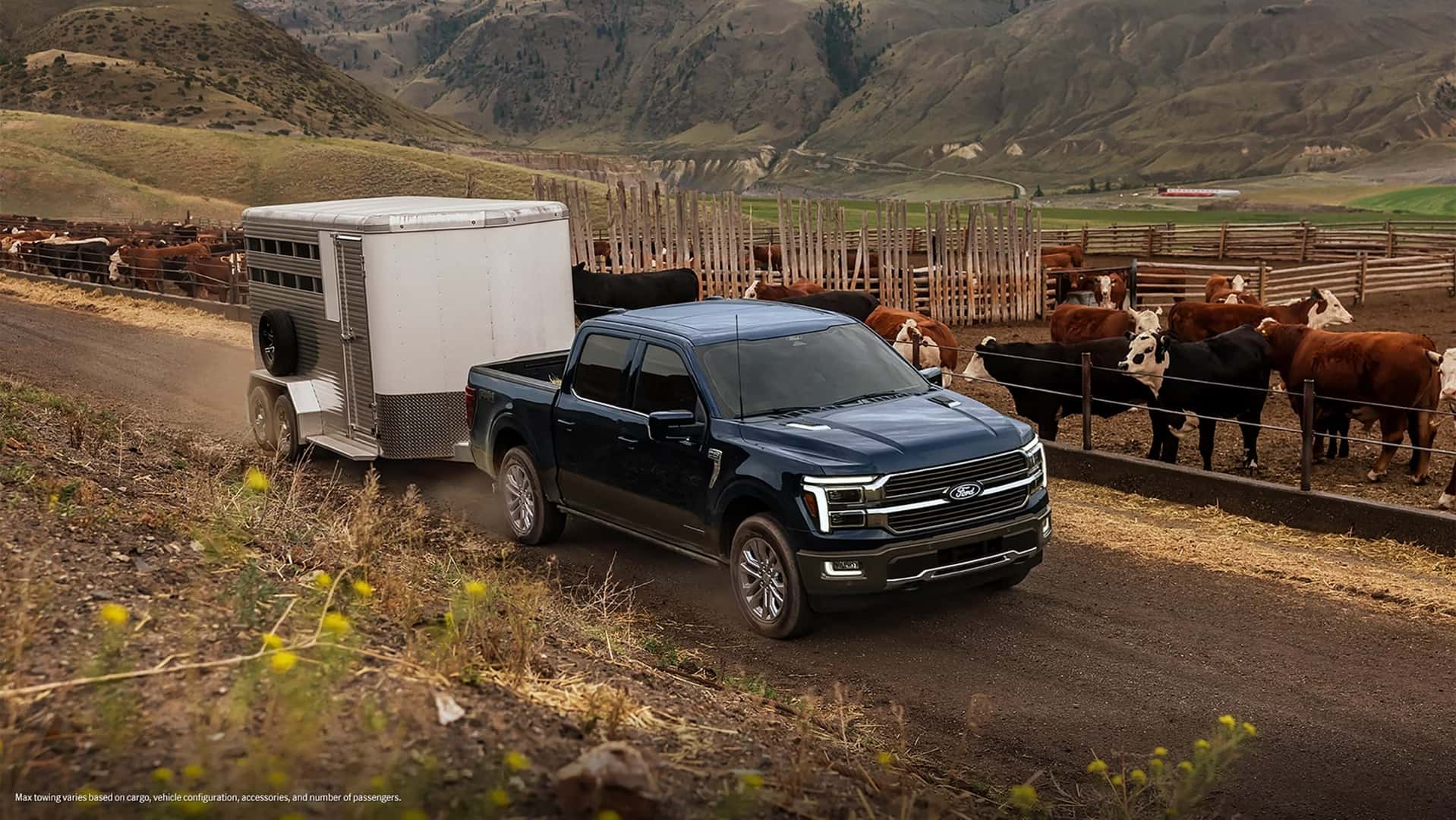
Towing Capacity and Hauling Performance: F-150 vs Ram 1500
For buyers who work their trucks, towing capacity drives the whole conversation. The numbers below reflect properly equipped configurations.
| Capability | 2026 Ford F-150 | 2026 Ram 1500 |
| Max Towing | 13,500 lbs | 11,610 lbs |
| Max Payload | 2,440 lbs | 2,360 lbs |
| Rear Suspension | Leaf-spring | Coil-spring |
The F-150’s 13,500 lb towing ceiling means it can handle large fifth-wheel campers, heavy equipment trailers, and loaded car haulers that simply fall outside the Ram’s 11,610 lb limit. That 1,890 lb gap is meaningful for drivers who regularly work near capacity. Payload figures also favor the F-150, which counts when you’re hauling gravel, mulch, or tools in the bed rather than on a hitch.
The F-150 backs up those numbers with serious towing-specific technology. Pro Trailer Backup Assist and available onboard scales are genuinely useful for drivers who haul irregularly or don’t have years of trailer experience behind them. The Ram tows competently and smoothly, but it doesn’t match that depth of towing tech.
Ride Quality and Daily Driving Comfort
That suspension difference in the table above has real consequences on the road. Ram’s coil-spring rear absorbs bumps more gradually, floats over rough patches, and feels closer to a well-tuned SUV when the bed is empty. Drivers who prioritize commuting comfort or family hauling will notice that difference almost immediately.
The F-150’s leaf-spring setup is built for a different purpose. It provides better stability and consistency under load, which is exactly what you want when you’re towing or carrying significant weight in the bed. When either truck is loaded, both suspensions become more composed and the gap between them narrows considerably. For daily driving without a heavy load, the Ram’s ride is more refined. For work use with a full bed or a trailer behind you, the F-150’s setup earns its place.
The right answer really depends on how you use the truck. A primary work vehicle benefits from the F-150’s load-carrying stability. A truck that doubles as a family hauler and rarely carries heavy loads will feel more comfortable in the Ram.
Interior Technology, Infotainment, and Driver-Assist Features
| Feature | 2026 Ford F-150 | 2026 Ram 1500 |
| Cab Options | Regular, SuperCab, SuperCrew | Quad Cab, Crew Cab |
| Max Cargo Volume | 77.4 cu ft (8-ft bed) | 61.5 cu ft |
| Max Seating | 6 | 6 |
| Upholstery Options | Cloth, Vinyl, Leather | Vinyl, Cloth, Leather |
The F-150 offers more cab and bed configurations, giving buyers flexibility that Ram’s two-cab lineup simply doesn’t match. Its available Pro Power Onboard system converts the truck into a mobile generator with up to 7.2 kW of exportable power, a practical differentiator for contractors running tools or equipment directly from the truck on a worksite.
Ram’s Uconnect 5 system is polished and intuitive, and upper trims feature soft-touch surfaces, real wood accents, and ambient lighting that rival some luxury SUVs. Both trucks now include adaptive cruise control, lane-keeping assist, and automatic emergency braking as standard or near-standard equipment.
If a premium interior feel is your priority, the Ram delivers it convincingly. If work-focused technology is the requirement, the F-150 is built around that use case.
Which Truck Is Right for You?
The F-150 is the stronger choice for heavy haulers, hybrid efficiency seekers, worksite users, and buyers who want more cab and bed configurations. Its towing advantage, PowerBoost hybrid option, available Pro Power Onboard, and deeper trailer management tools make it the more capable and versatile truck for most Montgomery-area drivers using their truck as a genuine work vehicle.
The Ram 1500 makes a compelling case for buyers who prioritize ride refinement and interior quality. If the truck primarily serves as a family vehicle and rarely pushes towing limits, the coil-spring suspension and premium cabin materials offer a daily driving experience that’s genuinely hard to match in this class.
For most buyers who need a truck that handles work and weekend life without compromise, the 2026 F-150 holds the edge. We’re happy to walk you through the options in detail. Explore our financing options to see what works for your budget before you visit.
Shop the 2026 Ford F-150 at Stivers Ford of Montgomery
We carry a strong inventory of 2026 F-150 models across multiple trims and configurations at Stivers Ford of Montgomery, and our team is ready to help you find the right build. Whether you’re drawn to the PowerBoost hybrid, the high-output 3.5L EcoBoost, or a work-ready base trim, there’s a version here for how you actually use a truck.
Browse available inventory online or reach out to our team to schedule a test drive. Come see the 2026 F-150 in person and find out why it continues to lead the full-size truck segment.
Images by OEM
0 comment(s) so far on 2026 Ford F-150 vs 2026 Ram 1500: Towing, Tech, and Ride Quality Differences